
NECESSARY ENEMIES
NOW FREE: You need the early, intrusive parent to build the machine; you need the rival to test it

Dear Readers,
Thank you for reading The Kureishi Chronicles. As I continue to write via dictation with the help of my family, your support means everything.
Please consider becoming a paid subscriber, it really makes a difference.
The other night, I found myself shouting at the television while watching the new Rafael Nadal documentary on Netflix, Rafa. “Give up,” I yelled. “Why don’t you just give up?”
Late in the series he is limping again, taped together, pushing his broken body through yet another cortisone‑assisted comeback. “You’ve won everything. You’ll kill yourself if you keep going.”
What would it mean for a man like Nadal to walk away from a project that began before he knew he had a life?
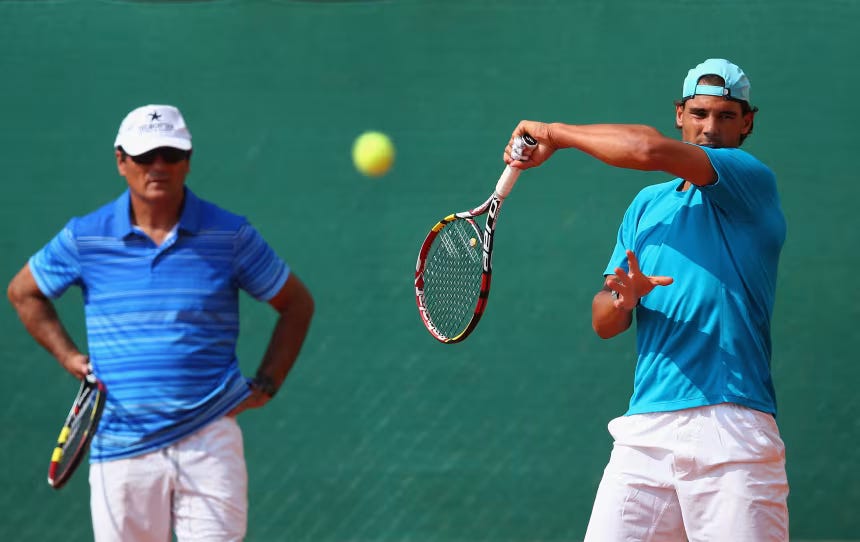
Toni Nadal, Rafa’s uncle and coach, his surrogate father, was the tormentor and architect of what we see: the endless drills, the refusal to give up, the theatre of pain – the devotion to suffering as a form of character-making.
Nadal describes his uncle’s training in the language of both gratitude and trauma: the ‘injustice’ of being singled out for harsher treatment than other children, made to play through extreme pain and fatigue, even without water. He insists that without this regime he “would not be the player I am today.”
Watching Rafa, you have the sense of a subject being used as material. Parents like this – or uncles acting as parents – make the child their proxy and second chance. Often these ‘parents’ are limited or failed performers: the thwarted club player, the frustrated painter, the immigrant father who drove a minicab so that his son would never have to. Their failure is fuel to create a star.
In these arrangements, the desires of parent and child begin to overlap until they are indistinguishable. A boy swinging a racket in the sun may genuinely enjoy tennis, or he may simply be enjoying the glow that comes from pleasing his coach.
The child’s desire is colonised before it’s had a chance to form. In families like these, desire or ambition is created and maintained by the parental figure. In Rafa’s case, he so internalises Toni’s logic – you are not good enough, you must train harder – that he not only becomes a twenty-two-time Grand Slam winner, but a bundle of neuroses: the child deprived of water can’t, as an adult, survive without a bottle of water in his hand.
For Freud, the child is drafted into the unfinished business of the parents: to console a depressed mother, vindicate a dishonoured father, or to avenge a class or race slight. In the realm of prodigies – sport, the arts, chess – this recompense becomes a full-time job. A missed note or lost match can be a re‑traumatisation of the parent.
James Mill, the father of the philosopher John Stuart Mill, became obsessed with the idea of raising a rational, utilitarian genius. By the age of three his son was learning Greek; by six he had written a history of Rome; by eight he was reading Plato in the original and tutoring his siblings. His childhood was a syllabus, ruthlessly designed by his father.
In his twenties, Mill suffered a severe depressive collapse and asked himself a terrifying question: “Suppose that all your objects in life were realised… would this be a great joy and happiness to you?” The answer, he wrote, was a simple “No,” and “the whole foundation on which my life was constructed fell down.”
Perhaps Mill was missing the point. The object of his studies was not for him to feel joy, but for his father to feel it through him, to continue the family name.
Nadal and Mill were constantly humiliated by their parents’ lack and inadequacies. A child trained like this is suspended in a kind of extended adolescence. The “sports parent” excludes the child from friendships that might complicate the schedule and from the boredom in which unexpected interests arise. They become slave‑like, bound by guilt, internalising the parent’s dogma. What space do they have for developing their own sexuality? For dreaming?
If the child does not become Nadal – if he quits the academy at fourteen, smokes weed and becomes a barista – then the screaming and the drills are seen plainly as cruelty. If he wins twenty‑two Grand Slams, we call the same behaviour “tough love” and make documentaries about his “warrior mentality.” If John Stuart Mill had gone mad and never recovered, we would speak of paternal brainwashing. Because he wrote On Liberty, we talk reverently of his education. The line between abuse and discipline is drawn retrospectively; the trophies supposedly proving the project was worthwhile.
At a certain point, the controlling parent has to give way to someone else. The child grows up, grows away, or simply reaches a level where parental expertise is exhausted. Into this vacuum steps the rival. If the parent’s job is to get you onto the stage or court, the rival’s is to keep you there, to push you beyond what the parent could imagine.
Federer, with his elegance and apparent effortlessness, was the first great mirror. He forced Nadal to develop a backhand, to risk going to the net. He made him improve on faster surfaces. Toni had to tell Nadal that Federer was better than him, and that unless he adapted, he’d never beat him. Federer was the beautiful enemy who brought out Nadal’s best.
Then came Djokovic, the man who refused to play the role allocated to him in the Federer‑Nadal romance. Djokovic pushed both of them harder, demanding not only physical resilience but tactical evolution. Nadal could no longer be defined by his uncle’s training methods. All too human, with his sweating, injuries and elaborate superstitions, Nadal had to overcome this new, seemingly infallible machine, while still facing off against the angel, Federer.
The arts have always understood the rival as a secret partner. Matisse called Picasso “the devil”; Picasso said, late in life, that after all was said and done “there is only Matisse.” Or F. Scott Fitzgerald and Hemingway, aligned in all their competitiveness and mutual admiration.
More explicitly filial was the relationship between Freud and Jung. Freud groomed Jung as his heir, then felt betrayed when Jung went his own way. The break between them – two men in late‑night letters, accusing each other of dogmatism and cowardice – reads like the final rupture between a domineering father and a newly adult son.
In these pairings, the rival often arrives once the parent has done their initial work. You need the early, intrusive parent to build the machine; you need the rival to test it. The rival offers what the parent never quite can, which is recognition from an equal. There is a kind of love there, forged in the knowledge that no one else knows exactly what it cost to get there.
Many of us, in choosing our rivals, quietly recreate our parents. If you had a Toni Nadal in childhood, you will likely find a version of him later on: in your boss or collaborator, even your lover.
Even for those of us who aren’t sports stars or geniuses, the parent’s voice remains omnipresent. I still hear my father’s writing injunctions: make it personal, short sentences, a strong story is essential.
For writers, there are always rivals who work as influences – not just in their ability, but in their subject matter, their form, the artistic decisions they make, how they conduct their career. These figures can be exhausting, but they are also sustaining. They keep you from giving up.
What happens if you no longer let yourself be used as someone’s material, even when that someone is a ghost? I suspect the answer is a mixture of relief and panic, a painful rediscovery of what you actually want when nobody is shouting.
This is a great one-- beautifully written and brimming with fascinating ideas. Thank you!
Another rivalry that comes to mind is Marlowe and Shakespeare. Will was spurned on by Marlowe’s education, writing, and early success. He worked hard to “overcome” and “outdo” his friend and rival.